SonarLens Blog
The New Word-of-Mouth Is an AI Recommendation
People used to ask friends, reviewers, and Google what to buy. Now they ask ChatGPT and Gemini. That makes AI reputation management a new priority for brands: knowing whether AI recommends you, how it describes you, which competitors it favors, and what sources shape the answer.
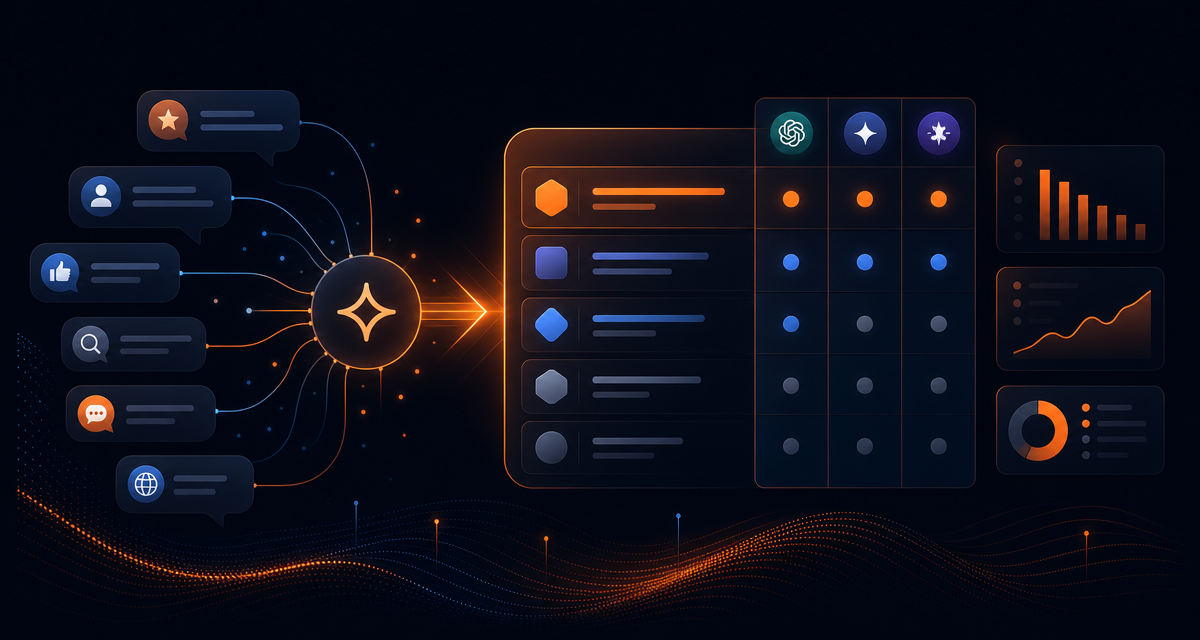
Word-of-mouth has always been one of the most powerful forces in brand reputation.
A friend says a restaurant is worth trying. A colleague recommends a software tool. A runner tells another runner which shoes held up through marathon training. The recommendation feels useful because it is personal, contextual, and usually not perceived as advertising.
AI assistants are starting to occupy that same space.
When someone asks ChatGPT or Gemini, “Which brand should I choose?”, they are not just searching. They are asking for a recommendation. The answer is framed like advice: direct, confident, and tailored to the person asking.
That creates a new reputation problem for brands.
You may know your review scores. You may track search rankings. You may monitor press coverage. But do you know what AI says when a potential customer asks for the best option in your category?
For many brands, the honest answer is no.
Reputation management used to be easier to see
Traditional reputation management has clear surfaces.
You can read your reviews. You can audit your Google results. You can track media coverage, comparison articles, forums, and customer feedback. None of it is simple, but at least the evidence is visible.
AI recommendations are different.
A potential customer may ask an assistant for advice, receive a shortlist, ask two follow-up questions, and make a decision without ever landing on your website or reading a review page directly. If your brand is not included, you may never know you lost the opportunity. If your brand is included but described incorrectly, you may not see that either.
The reputation moment still happened. It just happened inside a private conversation.
That is why AI reputation management is becoming a distinct discipline. It is not about controlling what AI says. It is about measuring what AI currently says, understanding why, and improving the information environment that shapes future recommendations.
AI recommendations behave like word-of-mouth
Traditional advertising tells people what a brand wants to say about itself.
Word-of-mouth tells people what others believe about the brand.
AI recommendations sit closer to the second category.
When an assistant recommends a product, service, or company, it usually does so by summarizing what it understands from public information: brand websites, reviews, articles, comparisons, product pages, forums, and other sources. The answer may combine reputation, positioning, category knowledge, and perceived fit for the user.
That gives AI recommendations several qualities that make them feel like modern word-of-mouth:
- They are conversational.
- They are contextual to the user’s needs.
- They compare brands directly.
- They usually include reasons, not just names.
- They can feel neutral because they are not obviously paid placement.
For buyers, that is convenient. For brands, it is uncomfortable.
Because the AI assistant may become the trusted intermediary between your market and your brand story.
The question is no longer only “What do people say about us?”
Reputation teams have traditionally cared about public perception. That still matters. But AI adds a new layer:
What does AI infer about us from the public record?
That is a different question.
A brand might have strong messaging on its own website, but AI may rely more heavily on third-party sources. A company might have repositioned recently, while older descriptions still dominate the model’s understanding. A product may have fixed a weakness, but outdated comparisons may still frame it as a concern. A competitor may be recommended for a strength your brand also has, simply because the competitor’s proof is easier for AI to find and summarize.
In traditional reputation management, teams often look for negative sentiment, damaging articles, bad reviews, or public complaints.
In AI reputation management, the risks are broader and sometimes quieter:
| Traditional reputation issue | AI reputation issue |
|---|---|
| A bad review is visible on a review site | AI summarizes a recurring concern as part of its recommendation |
| A competitor ranks above you in search | A competitor becomes the default AI recommendation |
| Your brand story is inconsistent across channels | AI gives a muddled or outdated explanation of what you are best for |
| You are known in the market but not differentiated | AI mentions you as an alternative, not a first-choice recommendation |
| You track public conversations after they happen | You test recommendation moments before they influence buyers |
The shift is subtle but important. AI does not just repeat reputation signals. It turns them into advice.
One AI answer is not your reputation
Many teams start by opening ChatGPT or Gemini and asking about their category.
That is a useful first check. It is not enough.
AI answers vary by question, model, and user context. A recommendation for a budget-conscious student may differ from a recommendation for an enterprise buyer. A casual user may receive a different shortlist than an expert. ChatGPT and Gemini may agree on some brands and diverge on others.
This means AI reputation is not a single answer. It is a pattern.
A serious view of AI reputation should show:
- How often your brand is recommended across relevant buying questions
- Which competitors appear more often, and in what position
- Which audiences receive your brand as a strong fit
- Which audiences do not see you at all
- What reasons AI gives for recommending or excluding you
- Which sources are cited or repeatedly used to support the answer
- Whether ChatGPT and Gemini tell the same story
- How the pattern changes over time
Without that structure, brands end up debating anecdotes. One person saw a good answer. Another saw a bad one. Someone changed the prompt and got a different result.
That is not reputation management. That is guesswork.
The “why” matters more than the mention
Being named by AI is useful. Being recommended for the right reasons is more useful.
If AI recommends your brand, what does it say you are good at? Quality? Price? ease of use? design? reliability? customer support? availability? performance? sustainability? category leadership?
Those reasons are reputation assets.
They show what the model believes your brand stands for. They also reveal whether your positioning is coming through clearly.
Sometimes the answer is encouraging. AI may describe your brand in language that closely matches how you want to be understood.
Other times, the answer exposes a gap. AI may recommend a competitor because of a feature you also offer. It may frame your brand as suitable for beginners when you are trying to reach advanced users. It may bring up concerns that are outdated. It may omit your strongest proof points entirely.
For brand, PR, SEO, and content teams, that is where AI reputation management becomes practical. The goal is not to “trick” the model. The goal is to understand the information shaping the recommendation and decide where your public brand story needs to be clearer, stronger, or more current.
Sources are the bridge between measurement and action
AI recommendations can feel opaque. Sources make them more concrete.
When AI cites or draws from particular articles, comparison pages, reviews, product pages, or publications, those sources become part of the reputation map. They help explain why certain brands are trusted, which claims are repeated, and which competitors are easier for AI to justify.
This is where traditional marketing work still matters.
Your website still matters. Reviews still matter. PR still matters. Category content still matters. Third-party comparisons still matter. But the measurement layer changes.
Instead of only asking, “Did this page rank?” or “Did this article get coverage?”, teams also need to ask:
Is this information shaping what AI recommends?
That is a more demanding question. It forces teams to connect reputation inputs to recommendation outputs.
AI reputation management is not crisis management
It is tempting to think about AI reputation only when something goes wrong.
A strange answer. A hallucinated claim. A competitor recommended instead of you. An outdated weakness repeated as if it were still true.
Those issues matter. But the bigger opportunity is ongoing measurement.
AI reputation management should become part of normal brand intelligence, especially in categories where people ask for recommendations before buying. That includes consumer products, B2B software, local services, healthcare-adjacent categories, travel, financial services, electronics, hospitality, and any market where trust and comparison matter.
The brands that monitor early will have a baseline. They will know where they are visible, where they are absent, and which competitor narratives are strongest. They will be able to see whether campaigns, content updates, PR activity, and market changes are reflected in AI recommendations over time.
The brands that wait may only discover the issue after the category narrative has already moved.
What brands should monitor now
A practical AI reputation program does not need to start with dozens of questions. It can start with the recommendation moments that matter most.
Pick the questions a real buyer would ask before choosing. Not “Tell me about our brand.” Not “Is our company good?” Start with category-level intent:
- “Which [category] should I buy?”
- “What is the best [product/service] for [specific need]?”
- “Which brands are worth considering for [audience]?”
- “What are the best alternatives to [competitor]?”
Then measure the answers across the audiences you care about.
The output should not be a screenshot. It should be a structured report: recommendation frequency, ranking patterns, competitor overlap, model differences, reasoning, sources, and audience breakdowns.
That is the difference between checking AI and managing AI reputation.
How SonarLens helps
SonarLens is built around a simple question:
AI recommends brands. Does it recommend yours?
Instead of asking a generic prompt once, SonarLens runs structured studies across ChatGPT and Gemini using realistic profiles based on real panel data.
You define the buying question. You describe the target audience in plain language. SonarLens creates profiles with demographic, lifestyle, psychographic, and consumer context, then queries AI as each profile.
The report shows which brands are recommended, how often they appear, how recommendations differ by audience, where ChatGPT and Gemini agree or diverge, what reasoning patterns appear, and which sources are cited.
For one-off studies, reports are ready in minutes. For ongoing monitoring, tracker subscriptions can run recurring studies on a monthly schedule.
The point is not to replace traditional reputation management. It is to add the missing layer: what AI says when buyers ask for advice.
The brands people hear about may be the brands AI recommends
Word-of-mouth used to travel through friends, colleagues, reviewers, communities, and search results.
Now it also travels through AI assistants.
That does not make every AI answer correct. It does make AI answers influential enough to measure.
If a potential customer asks for a recommendation and your brand is absent, that is a reputation signal. If your competitor is consistently framed as the safer choice, that is a reputation signal. If AI describes your brand in language your team would never use, that is a reputation signal too.
The new word-of-mouth is not only what people say about you.
It is what AI says when people ask what to choose.
Brands need to know the answer before their customers do.