SonarLens Blog
Google Search Results vs. AI Recommendations: What Brands Need to Measure
Google search tells you where your pages rank. AI recommendations tell you whether ChatGPT or Gemini would actually suggest your brand. They look similar from a distance, but they create very different visibility problems for marketers.
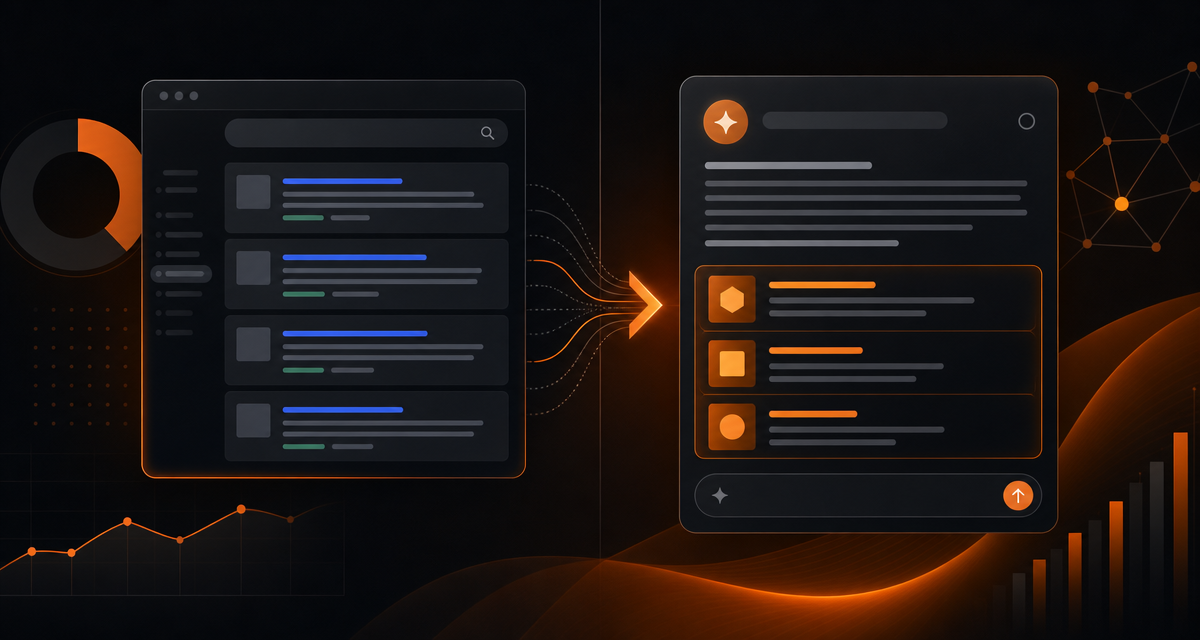
For years, Google search results were the clearest way to understand digital visibility.
If someone searched for your category, you wanted to know whether your brand appeared, where it ranked, which competitors were above you, and which pages were winning attention. That logic shaped SEO, content strategy, review management, PR, and paid search.
But AI assistants are changing the shape of discovery.
When someone asks ChatGPT or Gemini, “Which brand should I choose?”, they are not looking at a traditional results page. They are reading a synthesized answer. Often, that answer includes a recommendation, a shortlist, a comparison, or a reason why one brand fits better than another.
That means brand visibility now has two layers:
- Search visibility — where you appear in Google results.
- AI recommendation visibility — whether AI assistants recommend you, how they describe you, and which sources shape the answer.
Both matter. But they are not the same measurement problem.
Google results are a map. AI results are an answer.
A Google search result is usually a set of options. The user sees links, snippets, ads, maps, reviews, videos, shopping results, and other surfaces. The decision-making still happens largely outside the result itself.
The user clicks, compares, reads, returns, refines, and decides.
An AI result compresses more of that journey into one response.
Instead of showing a list of pages about running shoes, project management tools, skincare brands, or local restaurants, the assistant may say which brands are worth considering and why. It may compare strengths and weaknesses. It may tailor the answer to the person asking.
That shift matters because the brand is no longer only competing for a click. It is competing to be included in the answer.
In Google, being visible often means being findable.
In AI recommendations, being visible often means being selected.
The comparison that matters
Here is the practical difference for brand and marketing teams.
| Question | Google search results | AI recommendations |
|---|---|---|
| What does the user see? | A ranked set of links and search features | A synthesized answer, often with recommended brands |
| What is the brand trying to win? | Ranking, click-through, traffic, visibility | Inclusion, recommendation rate, positioning, reasoning |
| Who does the comparison? | Mostly the user | The AI assistant does much of the synthesis |
| How is success measured? | Rankings, impressions, clicks, traffic, conversions | Brand recommendations, ranking within answers, sources, sentiment, model agreement |
| How personal is the result? | Depends on query, location, history, and search surface | Can vary strongly based on the user profile and prompt context |
| What should teams monitor? | Keywords, pages, competitors, SERP features | Questions, audience segments, competitors, cited sources, reasoning patterns |
This is why a brand can have decent Google visibility and still be weak in AI recommendations.
Search visibility does not automatically translate into AI preference.
Google rewards pages. AI recommendations evaluate brands.
Traditional search measurement usually starts with pages.
Which landing page ranks? Which article brings traffic? Which competitor page is above ours? Which title tag performs better? Which queries are we missing?
Those are still useful questions.
AI recommendations start from a different place. The assistant is not simply deciding which page to show. It is forming an answer based on patterns it has learned, information it can access, sources it may cite, and the context provided by the user.
That creates a different set of questions:
- Does the AI recommend our brand at all?
- Which competitors does it recommend instead?
- What reasons does it give for choosing them?
- Does it position us as premium, affordable, reliable, niche, outdated, beginner-friendly, or risky?
- Which sources appear to support the answer?
- Does ChatGPT say something different from Gemini?
- Do recommendations change for different audiences?
For SEO teams, this can feel familiar but not identical. Content still matters. Reviews, third-party mentions, product information, and public reputation still matter. But the output is not a ranking page. It is a recommendation.
And recommendations need to be measured differently.
AI results vary by audience in ways Google reports often miss
One of the biggest mistakes brands make is testing AI visibility with a single generic prompt.
For example:
“What is the best running shoe brand?”
That may produce an interesting answer, but it is not enough to understand brand visibility. Real buyers bring context. They have budgets, locations, habits, needs, preferences, life stages, and constraints.
A beginner runner may get a different recommendation than a marathon runner. A price-sensitive student may get a different answer than a high-income professional. A buyer with sensitive skin, a small team, a rural location, or a specific use case may change the recommendation entirely.
This is where AI results become more complex than classic rank tracking.
In Google, teams often track keyword sets. In AI recommendations, teams also need to track audience context.
That is why SonarLens uses profiles based on real panel data. Instead of asking ChatGPT or Gemini one generic question, SonarLens queries the models as many different profiles, each with demographic, psychographic, lifestyle, and consumer context. The report then shows how recommendations change across the audience.
The practical question is not only:
“Does AI recommend us?”
It is:
“For which people does AI recommend us — and for which people does it recommend a competitor?”
AI model comparison is now part of brand intelligence
Google search results are not the only discovery surface anymore. ChatGPT and Gemini can also disagree.
One model may recommend your brand frequently. Another may favor a competitor. One may cite different sources. One may describe your strength as value for money, while another may frame you as a specialist option. Those differences are not just technical details. They affect how buyers understand your category.
For a marketing team, model disagreement can reveal useful gaps:
- Your brand may be visible in one AI assistant but not another.
- A competitor may have stronger association with a specific buying need.
- Certain sources may be shaping one model’s answer more than expected.
- Your positioning may be understood inconsistently across models.
This is similar to comparing visibility across different search engines, review sites, or marketplaces — except the output is more narrative and more influential at the decision stage.
Sources still matter, but the role of the source changes
In Google, the source is often the destination. The user clicks the article, product page, review, or category page.
In an AI response, the source may become part of the assistant’s reasoning. The user may not click anything. They may simply trust the answer.
That does not make sources less important. It makes them harder to inspect.
Brands need to know which sources AI assistants cite or appear to rely on when recommending products and services. Those sources may include your own site, review pages, editorial content, product comparisons, category guides, or competitor content.
The important shift is this:
Google source visibility asks, “Which pages are ranking?”
AI source visibility asks, “Which sources are shaping the recommendation?”
Those are related, but not identical.
What to measure beyond Google rankings
If your team already tracks SEO performance, you do not need to throw that work away. Google still matters. Search traffic still matters. Ranking for high-intent category terms still matters.
But AI recommendations add a new measurement layer.
At minimum, brands should start tracking:
Recommendation rate
How often does your brand appear in AI answers for important category questions?
This is the AI equivalent of being present in the consideration set. If your competitors are recommended and you are absent, the buyer may never know to compare you.
Position within the answer
When your brand appears, where does it appear? First recommendation, middle of the list, honorable mention, or only in a caveat?
AI answers are not always formal rankings, but order and framing still matter.
Competitive overlap
Which brands appear alongside yours? Which brands replace yours? Which competitors dominate certain audience segments?
This helps teams see the competitive map from the AI assistant’s perspective.
Reasoning patterns
Why does the assistant recommend each brand? Price, quality, reputation, availability, features, design, trust, simplicity, customer support, sustainability, performance?
The reasons are often more useful than the mention itself.
Audience breakdown
Which profiles get your brand recommended? Which profiles do not?
This is especially important for brands with multiple segments, price tiers, use cases, or regional positioning.
Model agreement
Do ChatGPT and Gemini agree on your category? If not, where do they diverge?
Agreement can suggest a stronger market signal. Disagreement can reveal uncertainty or inconsistency.
Sources
Which websites, articles, or pages are cited most often? Are your own assets present? Are third-party sources shaping the story? Are competitors benefiting from sources you have not considered?
This is where SEO, PR, content, and brand teams can work together.
Why manual AI testing is not enough
It is tempting to open ChatGPT or Gemini, ask a few category questions, and treat the answers as a signal.
That is a reasonable first look. It is not a measurement system.
Manual testing has several problems:
- One prompt does not represent your audience.
- One answer does not show frequency or variation.
- One model does not show the full landscape.
- One person’s test can be biased by wording and context.
- Results are hard to compare over time.
For brand intelligence, the goal is not to collect anecdotes. The goal is to produce a structured view of how AI assistants talk about your brand across questions, profiles, and models.
That is the gap SonarLens is built to fill.
You define the question, choose the audience, and get a report showing top recommendations, audience breakdowns, model comparison, brand details, sources, and key findings. Instead of relying on a single generic answer, you can see patterns across many profiles.
The practical takeaway
Google search results and AI recommendations are now two different visibility surfaces.
Google tells you whether people can find your pages.
AI recommendations tell you whether assistants would put your brand into the buyer’s consideration set.
A strong digital brand strategy needs both views. Search rankings show where you stand in the traditional discovery journey. AI visibility shows how your brand is being interpreted, compared, and recommended when the user asks for advice directly.
For marketers, the next step is not to guess what AI says. It is to measure it with the same seriousness you already bring to search, reviews, and competitive tracking.
Because if AI assistants are recommending brands in your category, the important question is simple:
Are they recommending yours?