SonarLens Blog
One AI Answer Is Not Brand Intelligence
Asking ChatGPT or Gemini about your brand once can be useful, but it is not measurement. To understand AI recommendations, brands need structured reports across profiles, questions, and models.
It is tempting to test your brand’s AI visibility in the simplest possible way.
Open ChatGPT or Gemini. Ask a category question. See whether your brand appears.
For example:
“Which running shoes should I buy?”
or:
“What is the best project management tool for a small team?”
If your brand appears, that feels reassuring. If it does not, that feels concerning.
But a single AI answer is not brand intelligence. It is one answer, from one model, to one question, at one moment, with little context about the person asking.
For brand managers, marketers, and researchers, that is not enough to make decisions.
The problem with testing AI recommendations manually
Manual testing can be a useful starting point. It helps you see how an assistant frames a category, what language it uses, and which competitors appear in the answer.
The problem starts when teams treat that single response as evidence.
AI recommendations are not static search rankings. They can change based on the phrasing of the question, the context provided, the model being used, and the type of person the assistant is responding to.
A generic question usually produces a generic answer. But real buyers are not generic. They have budgets, preferences, locations, needs, constraints, and habits. A parent buying skincare for a teenager may get a different recommendation than someone with sensitive skin. A first-time marathon runner may get different shoe advice than an experienced runner replacing a race-day pair.
That is the point: AI recommendations are contextual.
So if you only test one question as yourself, you are not measuring what AI says to your market. You are measuring what AI says to you.
What brands actually need to know
The important question is not simply, “Did ChatGPT mention us?”
A better set of questions looks like this:
- How often is our brand recommended across realistic buyer profiles?
- Which competitors are recommended more often?
- Are we recommended for the right reasons?
- Do recommendations change by age, lifestyle, region, budget, or use case?
- Does ChatGPT treat the category differently than Gemini?
- Which sources appear to shape the answer?
- Are we present in the shortlist, or only mentioned as an alternative?
Those questions move the discussion from anecdote to measurement.
They also reveal the difference between being known and being recommended. A brand may appear in an AI answer because it is widely recognized, but still lose the actual recommendation to a competitor that is described as more suitable, more affordable, more specialized, or more trusted for a particular need.
For marketing teams, that distinction matters.
Why profiles change the answer
One of the biggest weaknesses of manual AI testing is the lack of audience context.
Most brand questions are really audience questions. “Which brand should I choose?” depends heavily on who is asking.
A strong AI visibility report should not only test a category prompt. It should test that prompt through the lens of the people you care about reaching.
That means using profiles with demographic, psychographic, lifestyle, and consumer context. Not because profiles are perfect predictions of individual behavior, but because they make the test closer to the real recommendation moment.
Someone asking for a product recommendation rarely wants the abstract “best” brand. They want the right fit for their situation.
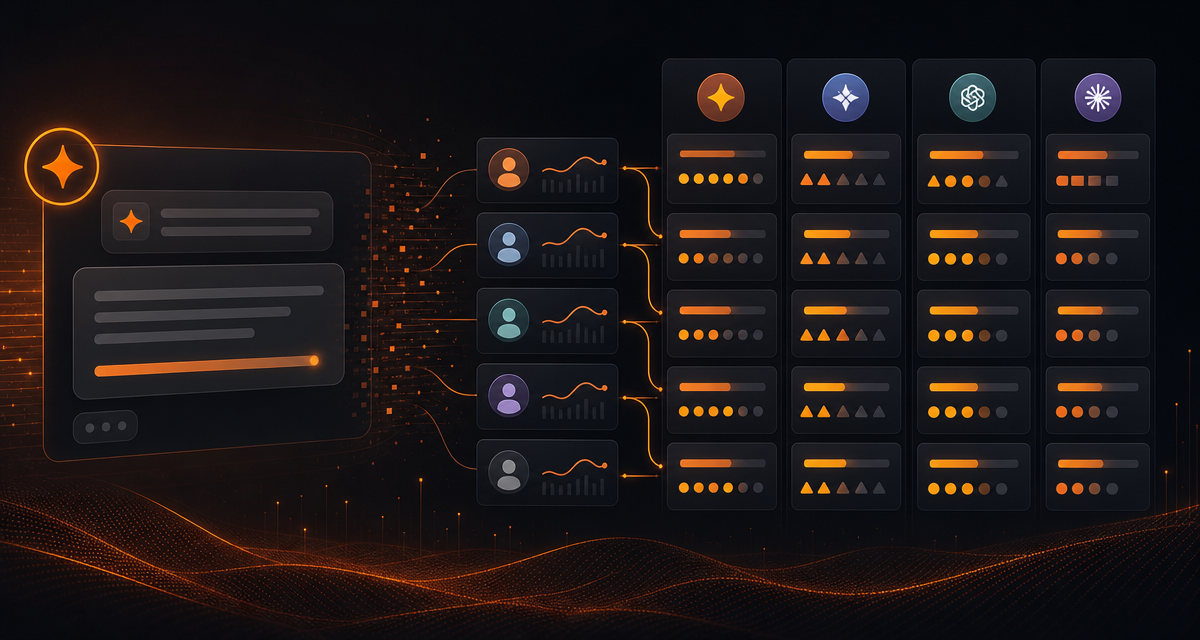
That is why SonarLens uses panel data to create realistic profiles, then queries ChatGPT and Gemini with each profile as context. The goal is to see how AI assistants respond when the buyer is not anonymous.
The result is a more useful view of AI recommendations: not just what gets mentioned, but who gets told what, and why.
Model comparison matters too
Another reason one AI answer is not enough: different models can disagree.
ChatGPT and Gemini may recommend different brands, cite different sources, or explain the same recommendation in different ways. They may agree on the category leader but diverge on niche alternatives. They may use similar reasoning, or they may frame the category around different buying criteria.
For a brand team, that disagreement is valuable.
If both models recommend the same competitor across many profiles, that is a signal worth investigating. If your brand appears strongly in one model but not the other, that suggests your AI visibility is uneven. If the sources differ, your content and PR teams may need to understand which information is being surfaced and where gaps exist.
A single answer hides those patterns. A structured report makes them visible.
What a structured AI recommendation report should include
A useful report should give teams more than screenshots of AI responses.
At minimum, brands should be able to see:
Top recommendations. Which brands and products are recommended most often across the study.
Audience breakdowns. How recommendations change across different profiles and segments.
Model comparison. Where ChatGPT and Gemini agree, where they diverge, and which brands each model favors.
Reasoning patterns. The strengths, weaknesses, and decision factors AI associates with each brand.
Sources. Which websites, articles, or pages are referenced most often.
Brand-level detail. Whether a specific brand is recommended, how it is described, and which competitors appear nearby.
This is the difference between “I asked ChatGPT and here is what it said” and “We measured how AI recommends brands in our category.”
How SonarLens approaches it
SonarLens is built for structured AI recommendation studies.
You define the question you want to test, choose the audience you care about, and get a report showing how ChatGPT and Gemini respond across realistic profiles.
The report extracts brand recommendations, rankings, sources, model agreement, audience differences, and reasoning patterns. Instead of relying on a single prompt, you get a broader view of how AI assistants talk about your brand and your competitors.
That matters because AI discovery is becoming a real brand channel. People are not only using assistants to summarize information. They are asking what to buy, which provider to choose, which product fits their needs, and which brands are worth considering.
If your team only checks that manually once in a while, you are seeing fragments.
Brand intelligence requires the full pattern.
The takeaway
One AI answer can start a conversation.
It should not end one.
If you want to understand whether AI recommends your brand, you need to measure recommendations across profiles, questions, and models. You need to know where you appear, where competitors win, what reasons AI gives, and which sources shape the response.
That is the move from curiosity to evidence.
And it is the difference between asking AI about your brand and actually measuring your brand’s place in AI recommendations.